

FAYETTE COUNTY, Ga. – To reach U.S. Soccer’s new national training center, drive 10 miles southwest of Atlanta’s international airport and leave I-85 in Union City. Pass the ribbon of car dealerships and the BBQ spot before turning onto a two-lane road lancing a pine forest. At the roundabout, wave to the pretty brown horses.
The last leg to the 200-acre site looks like the entry into an upmarket housing development carved into an exurb anywhere in America. Ahead, though, sits not single-family homes and a pool house but the future heart and headquarters of American soccer.
Draft your Yahoo Fantasy Baseball team for the 2026 MLB Season
When the Arthur M. Blank U.S. Soccer National Training Center opens in May, all 27 national teams sponsored by the sport’s domestic governing body, headlined by the senior men’s and women’s programs, will have a permanent home for the first time.
No longer will the U.S. Soccer Federation need to reserve space months ahead of time and negotiate rent at various facilities around the country.
Such was the case the past week as the men’s national team trained at Major League Soccer’s Atlanta United complex as part of preparations for two friendlies at Mercedes-Benz Stadium. At the same time, United and its youth academy maintained their own routines.
“We’re the guests at any facility where we are right now, and while we have very gracious hosts, we could be the fourth, fifth or sixth team in priority of using a facility in a day,” said JT Batson, the USSF’s chief executive and secretary general. “Some of our coaching staff describe it as sort of the ‘planning tax’ that goes into any of our camps right now. You’re spending a whole lot of time on logistics, and that eats into the time you can spend on all of the other things we know are so important.”
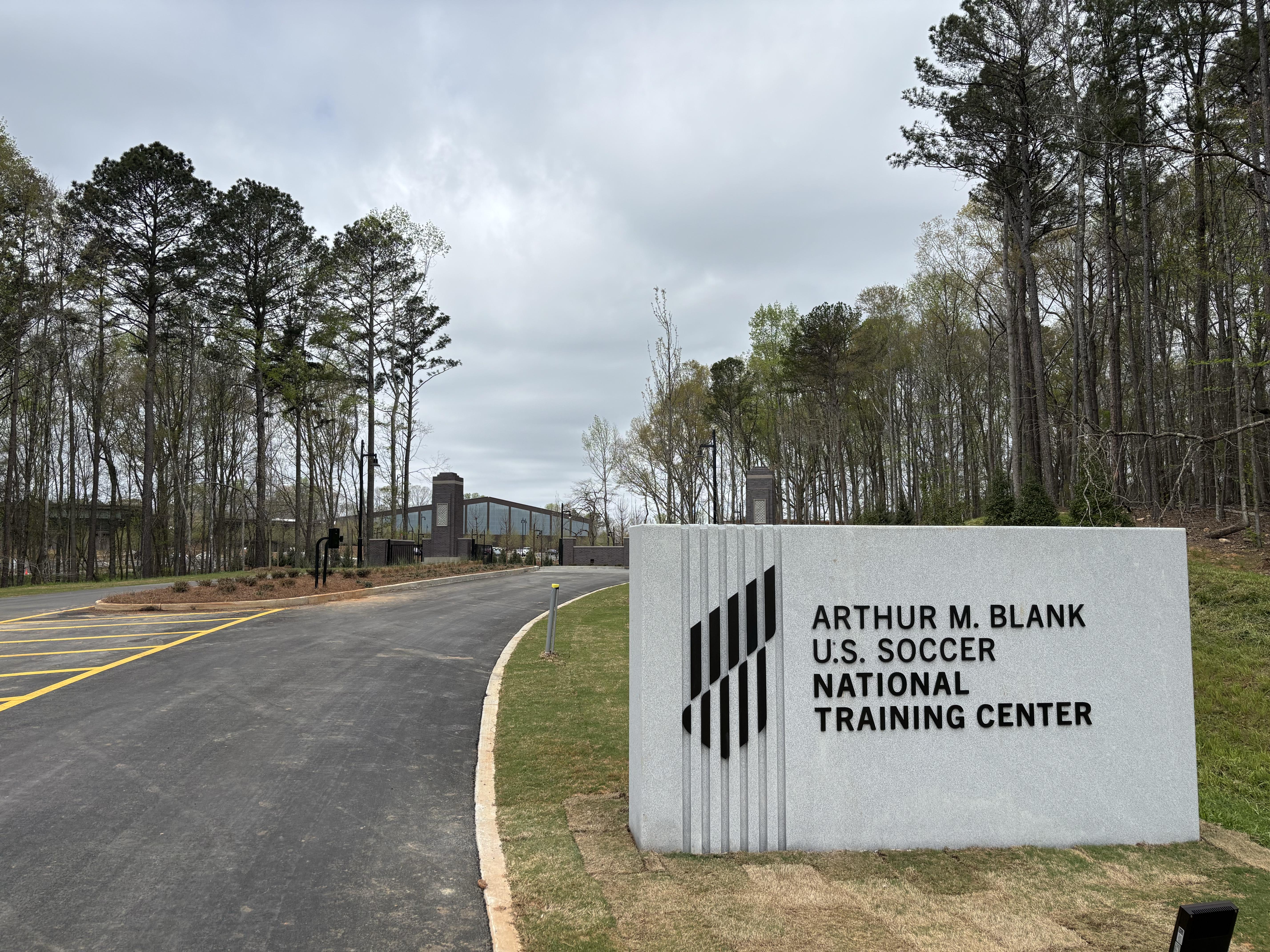
Less than two years after groundbreaking ceremonies, the $228 million campus features 13 grass fields, two artificial turf fields, two sand pitches for beach soccer, a 115,000 square foot indoor structure with artificial turf and a second indoor facility with a wooden floor for indoor soccer and power soccer (wheelchairs).
There is a high-performance center for weight training, fitness, conditioning and nutrition. Sixteen locker rooms are located on the first level of the two-story primary building and four others are adjacent to fields designated for youth teams. (The power soccer team’s locker room is equipped with recharging portals for the wheelchairs.)
There are whirlpools, a ballroom, conference rooms, offices, 400 work stations, medical facilities, cafeterias and even a sleep room. Second-floor terraces overlook the senior field and several pitches in the distance.
A ribbon-cutting ceremony will take place May 7 and the first work day will be May 18. The first event will be the Adapt and Thrive Invitational for the disabled national teams.
On May 27, one day after Mauricio Pochettino announces his 26-man World Cup squad, the team will train at the new complex before relocating to its tournament base camp in Irvine, California, ahead of the Group D opener against Paraguay on June 12 in Greater Los Angeles.
To maintain suspense for all players who will use the center, U.S. officials have kept things under wraps. Weekend tours for reporters, former players and special guests came with strict instructions not to take photos or video except in designated outside areas.
With all teams under the same roof, figuratively if not always literally, U.S. officials want to foster a united culture.
“We’re not one team. We’re 27 teams all playing for the same reason for the country,” said Matt Crocker, the USSF’s sporting director. “So we want to create that field where every one of those 27 teams feels connected to more than just their individual team. We want it to be bigger and better than that.”
Crocker said the USSF sought to create a “club feel” in which younger players interact with senior players and staff when camps overlap.
“We want our under-15s to be bumping into Mauricio or Emma” Hayes, the women’s coach, Crocker said. “You want to see your role models, be able to see how they train, see how they interact and then to generate some sort of connection between those groups.”
The campus design is also aspirational: Practicing on lower fields, young players must gaze up to see senior pitches on higher ground.
The closest the USSF has had to a permanent base is Dignity Health Sports Park in Carson, California — a privately owned complex on the Cal State Dominguez Hills campus. Soccer is at the forefront but the facility is also home to a tennis stadium, plus track and field and cycling facilities. The USSF also has a facility in Kansas City, Missouri, and will continue using both venues as needed.
For now, players coming to the new center will reside in nearby hotels, but with about 80 undeveloped acres on the property, the USSF is looking into constructing its own lodging.
The new training center will change how the senior squads operate during international windows featuring home friendlies. Instead of setting up camp in the city where the first match is being played, teams will typically train at the Georgia base and travel to the host venue a day or two before the game.
U.S. officials said they toured several sports facilities around the world to gather ideas and insight. One of the most famous in soccer circles is France’s Clairfontaine, which opened in 1988 and sits about 30 miles southwest of Paris. The French Football Federation’s headquarters, though, have remained in the capital. The new U.S. complex will house all business and media operations; previously they were in Chicago.
USSF’s strategic location in Greater Atlanta
So why the Atlanta area? Reasons included the ability to train outdoors most of the year; close proximity to a major airport serving most of the world; and a vibrant metro area that could appeal to employees. As with any corporate relocation, of course, many workers have left the USSF in order to remain in Chicago.
Coca-Cola, a USSF sponsor anchored in Atlanta, is a founding partner of the training center. The property was donated by the Cathy family, which owns Georgia-based Chick-fil-A and has developed land around Fayetteville, the closest city to the soccer complex.
A few miles down the road sits Cathy-affiliated Trilith Studios, the largest movie production facility outside of Hollywood. Across the street from the studio is a small mixed-use development featuring shops, restaurants and a hotel run by Marriott, a USSF sponsor.
The soccer complex is named after billionaire Arthur M. Blank, owner of the Atlanta Falcons and Atlanta United, who contributed $50 million to the project. Michele Kang — who owns the Washington Spirit in the National Women’s Soccer League and in 2024 pledged $30 million to U.S. women’s soccer initiatives — committed an undisclosed amount to the Georgia project.
It wasn’t so long ago U.S. senior teams were training on college campuses and auxiliary fields outside stadiums. Now they’ve got this.
“We’re going to need to evolve and grow into the building,” Crocker said. “We’ll hit hiccups along the way, but the idea is to make sure we can address those things as they pop up and know we’re not going to be perfect from day one. But our intention is to evolve into this amazing facility.”
The space is also available to the public for non-sporting purposes.
“So anyone with a birthday party, Bar Mitzvah or wedding, we’re ready for you,” Batson said.